
Jackson City Directory Holdings
The Tennessee Room at Jackson-Madison County Library is the local starting point for Jackson city directories. It is a non-circulating, staff-assisted local-history room at 433 E. Lafayette Street, open Monday through Saturday from 9 a.m. to 5 p.m. Call 731-300-3980 before a visit when an original or a particular reel is needed. Its reported holdings exceed 5,000 books and 1,945 microfilm rolls, alongside maps, newspapers, funeral records, photographs, original collections, and in-library Ancestry access.
Jackson directory coverage is not one uninterrupted run. The documented catalog sources below identify available years and access channels. Confirm an exact volume with the library or archive before traveling because the local inventory PDF was not machine-readable during research.
| Collection | Years | Where held | Access |
|---|---|---|---|
| Jackson directories, early run | 1904-1913 | Allen County Public Library digitized/held collection | Digital catalog or repository access |
| Jackson directory catalog entries | 1937, 1942, 1947, 1948, 1950, 1952, 1954, 1957-1960 | Tennessee Room and broader directory catalog | Confirm volume and format with custodian |
| Polk Jackson directories | 1998-1999, 2000-2007, 2009-2015 | Tennessee State Library and Archives | Archive holdings |
| WPA Directory of Jackson | Year not identified | TSLA, WPA microfilm roll 56 | Microfilm inquiry |
These dates describe reported holdings, not a promise that every calendar year survives. Gaps should be treated as gaps. Use an adjacent volume, census, newspaper, deed, or obituary rather than guessing what an unlocated year would have said.
Jackson Directory Research at Tennessee Room
The Tennessee Room gives a Jackson historical-directory search several practical fallbacks. Staff assist with original materials, and the library accepts inquiries for an obituary, Madison County history, property information, or a newspaper article. Its local collection includes directories, county records, maps, vertical files, and historic newspapers. That combination helps when an alphabetical entry turns up a name but the household relationship, street change, or death date remains uncertain.
Jackson Planning supplies the modern context for streets and subdivisions that appear in the older volumes.

Planning material can help distinguish an old central-grid address from a later subdivision reference, but it does not replace the directory page or a recorded plat.
Ask staff for the volume year, its alphabetical or street arrangement, and any handling rules. Original collections are staff-assisted, and the room’s materials do not circulate. Those details matter when the search depends on a single address section or a page that uses local abbreviations.
Jackson City Directory Early Years
The documented early Jackson directory run is 1904 through 1913, with records digitized or held through Allen County Public Library. It is the clearest early sequence identified for the city. A name that first appears there can be followed through a stretch of annual listings, while a missing name may require a look at the street section, variant spellings, or the next available volume.
Madison County’s older record framework reaches farther back. The Tennessee State Library and Archives Madison County guide identifies deeds and minutes from 1821, wills from 1825, marriages from 1838, and tax books from 1897. Those sources are not substitutes for an early directory volume, but they can place a surname before the directory run starts or clarify a land reference behind an address.
Note: An early directory describes the publisher’s listing at that time, so confirm a household relationship with another dated record.
Jackson City Directory Polk Runs
The later Jackson record includes Polk volumes for 1998-1999, 2000-2007, and 2009-2015 at the Tennessee State Library and Archives. The listed break between 2007 and 2009 should remain visible in a research log. It is not evidence that a household left Jackson, and no final printed year was verified.
The same guide identifies a WPA “Directory of Jackson, Tennessee” on roll 56, but does not give that directory’s year. Record the roll and the source wording rather than assigning it a date. WPA rolls also preserve early county, circuit, and chancery minutes, tax and marriage records, deed books, wills, and inventories, which can provide a broader family-history trail when an address entry is thin.
| Directory timeline | Documented milestone |
|---|---|
| 1904-1913 | Early Jackson directory run identified through Allen County Public Library holdings. |
| 1937-1960 | Scattered documented catalog years, including 1937, 1942, 1947, 1948, 1950, 1952, 1954, and 1957-1960. |
| 1998-2007 | Listed Polk volumes at TSLA, following the 1998-1999 run. |
| 2009-2015 | Listed Polk volumes resume after the documented break. |
| WPA directory | Held on roll 56, with no exact year identified. |
Jackson’s master-planning material depicts named subareas that add later geographic context to a Jackson directory address.

That current planning view is not evidence of an earlier mailing address, but it can keep a researcher from treating the city’s later growth areas as part of the older street grid.
Reading a Jackson City Directory Entry
A Jackson directory entry should be read as a bundle of clues, not as a standardized modern form. The research did not inspect a scanned Jackson sample page or abbreviation key, so the field inventory below describes common directory elements that may appear. Check the key in the exact volume before expanding a mark or deciding that a notation applies to a particular household.
| Name | The listed person, sometimes with initials, a suffix, or a spouse in parentheses. |
|---|---|
| Occupation or employer | A work or business clue when the volume includes it. |
| Street address | The residence or business location printed for that entry. |
| Householder mark | An owner, renter, householder, widow, or other notation where the volume uses one. |
| Telephone or business listing | A contact or commercial listing if the edition includes it. |
- Criss-cross directory
- A reverse section arranged by street address, used to move from a property to a listed occupant.
- Householder index
- An arrangement that points to the named head of a listed household; its exact treatment varies by volume.
- Abbreviation key
- The volume’s guide to shortened labels and marks. Consult it before interpreting a residence, business, or relationship notation.
A criss-cross section can help with a known old address, but the exact Jackson run for printed reverse directories was not located. The Tennessee Room specifically notes that old city directories can reveal who lived at an address in a particular year. It does not turn a historic address hit into proof of current occupancy.
Jackson Directory Clues and Obituaries
Jackson city directories work especially well beside the Tennessee Room obituary index. The index begins in 1936 and follows the most consistent sequence of The Jackson Sun. Its PDF blocks cover 1936-1939, 1940-1944, 1945-1949, and 1950-1954, and the library offers a request-a-copy route. Jimmy Wilkins created the index through years of reading newspaper issues, a local preservation effort that makes a disappearing directory name easier to investigate.
National Archives census access is the second useful companion for a household timeline.
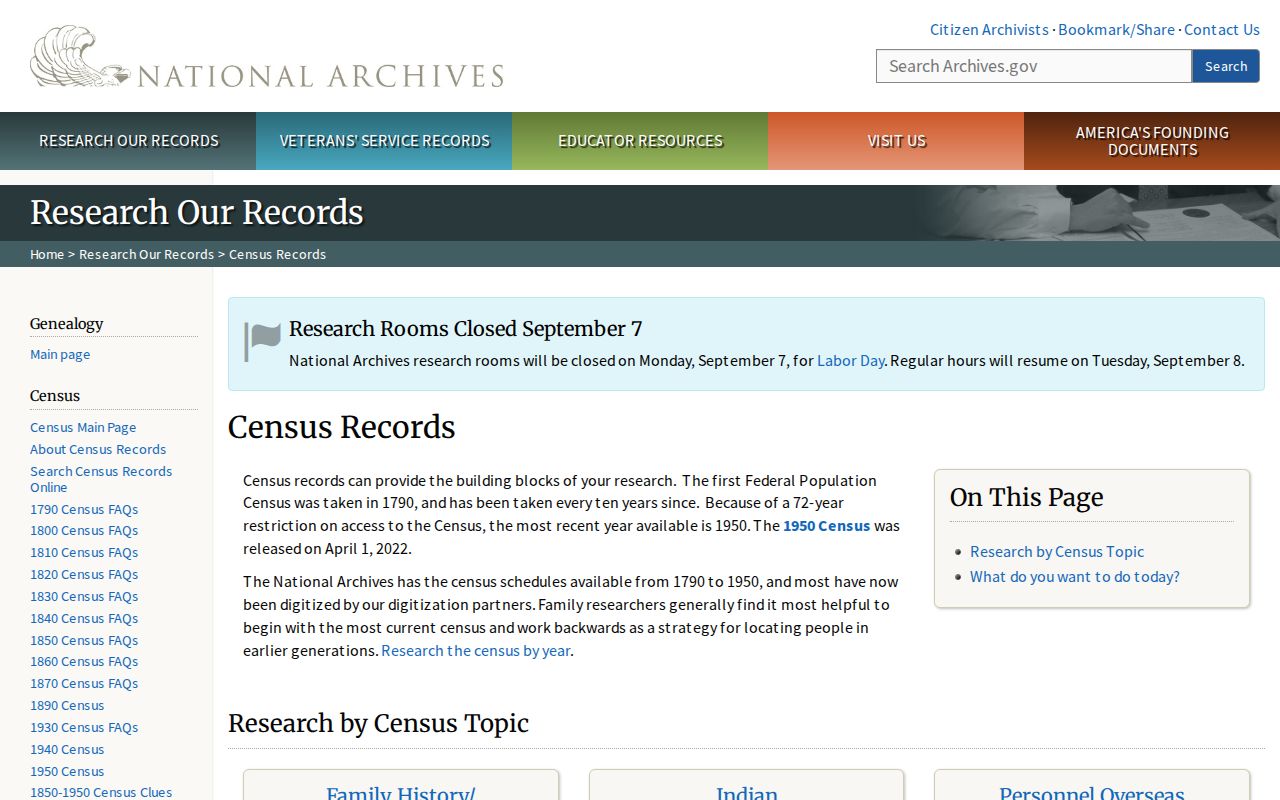
A newspaper notice or census household may explain a move, a death, or a changed family composition that an annual listing alone cannot settle. The Tennessee Room’s historic-newspaper access includes a complete ProQuest run of The Jackson Sun from 1936 through 2011, plus scattered issues beginning in 1823.
Jackson City Directory Census Pairing
A directory volume fills years between federal census enumerations. The Tennessee Room lists federal schedules through 1950. Under the National Archives 72-year release rule, 1960 is scheduled to open in 2032. Pair the volume closest to the census year, then compare names, occupations, address, and household composition rather than treating either record as complete by itself.
- Find the first Jackson directory year where the surname or address appears.
- Follow each available listing forward, saving the spelling, address, occupation, and any relationship mark exactly as printed.
- Check the street section only when the volume offers one, and record the page and year for an address result.
- Pair a 1937 directory with the 1940 census, or a 1950 directory with the 1950 census, to test household details.
- Use the obituary index, newspaper, deed, or probate material to investigate a disappearance or a later family connection.
Do not assume that an omitted person died or moved. Some people were not listed, a name may be abbreviated, and directories change their editorial coverage. A dated source trail is stronger than a conclusion drawn from one blank year.
Jackson City Directory Myth Check
Myth: a historical directory is the same as a census or a complete household list. It is not. A directory can list a name, address, occupation, business, or telephone number depending on the edition, while census schedules are federal household snapshots. A property record identifies a titled owner, which can be someone else. Each source answers a different question.
For a current, one-person record question, a historical listing can be one starting point, but it needs modern confirmation from the relevant custodian. The Jackson resident lookup route focuses on that separate verification task. Note: Preserve the source title, volume year, page, and repository whenever a directory entry is used in family research.
Jackson City Directory Collection Story
The Tennessee Room is more than a shelf of Jackson city directories. Emma Inman Williams, known as Miss Emmy, was a teacher, writer, editor, historian, and the room’s first librarian from 1972 to 1986. Her work shaped the local-history collection that supports present-day directory research. Historic Madison appeared in 1946, 1972, and 1986 editions, adding another local-history route when a directory name needs community context.
Special collections can add detail without being treated as current resident evidence. The Tennessee Room identifies the Gold Is The Key supplement for 1852-1856, Harris-Spencer WWII letters from 1941-1945, an Isaac Burton Tigrett collection covering the 1920s through the 1970s, the Jackson Schools Photograph Album from 1900-1910, the John D. Bond Diary, Timberlake papers, Sue Shelton White papers, and Jackson Jewish-history materials. A surname appearing in one of these sources needs its own citation and date.
Use those collections to understand a family’s school, community, religious, or business context after the directory and census record are established. They are especially useful when an address repeats across years but the household’s local connection is still unclear. They should not be used to infer a private person’s current location.